Are Inground Pools Worth the Insurance Cost?
Last Updated: November 5, 2026
Quick Summary
Most standard homeowners policies extend coverage to an inground pool, but pool insurance requirements and costs depend on your liability limit, pool features, deductible and coverage basis, and claims history. There is no universal premium, so ask your agent for a side-by-side comparison of coverage configurations before you build.
- Other structures coverage usually applies to the pool shell, liner, deck, and safety fence.
- Raising liability from $100,000 to $300,000 is a modest premium increase for most homeowners.
- Diving boards and slides may raise premiums, trigger exclusions, or cause insurers to decline coverage.
- Confirm in the contract who carries builder's risk on the work in progress.
- Earth movement and settling exclusions are common and may deny excavation-related claims.
Table of Contents
- Does Homeowners Insurance Cover Swimming Pools?
- Homeowners Insurance Pool Liability Coverage: How Much Do You Need?
- Swimming Pool Insurance Cost: What Drives Your Premium Up
- Pool Fence Insurance Requirements and Other Safety Rules
- Coverage Gaps to Watch: Construction, Renovation, and Claims
- Your Pre-Installation Insurance Review Checklist
- Planning a Pool Project? Start With a Consultation
- Frequently Asked Questions
Does Homeowners Insurance Cover Swimming Pools?
Yes, most standard homeowners policies extend coverage to an inground pool, but the details matter more than the yes. Homeowners should review inground pool insurance requirements and costs before the first shovel hits the ground.
Homeowners insurance for a pool splits into two jobs: covering the pool as property, and covering what happens to people around it.
What Dwelling and Other Structures Coverage Protects
Dwelling coverage protects structures attached to your home. Other structures coverage protects detached property on your lot, and that is usually where an inground pool lands.
- The pool shell, liner, and surrounding deck typically fall under other structures coverage
- Pool equipment like the pump, filter, and heater may be covered as personal property or as part of the structure, depending on the policy
- A pool enclosure or safety fence is generally treated as a structure
A pool built years ago may cost far more to replace now than its depreciated value suggests. Ask your agent which basis applies.
What Standard Policies Exclude
A standard policy is not a maintenance contract. Common exclusions include:
- Wear and tear, fading, and gradual deterioration
- Damage from poor maintenance or neglect
- Earth movement and settling
Watch out: skipping a season of water chemistry or pump service can turn a small repair into a denied claim.
Homeowners Insurance Pool Liability Coverage: How Much Do You Need?
Personal liability coverage pays when someone is hurt at your pool and you are held responsible. It covers bodily injury and property damage claims, plus legal defense costs.
Most homeowners carry liability limits that feel generous until a serious injury happens. Many insurers and advisors suggest raising your liability limit once a pool is on the property.
Medical Payments Coverage for Guests
Medical payments coverage pays small injury claims for guests without requiring a lawsuit or a fault finding. It is a goodwill coverage, modest by design.
- A neighbor's child slips on wet decking and needs stitches
- A friend twists an ankle on the steps
- A guest needs a quick trip to urgent care
Medical payments coverage can handle those bills up to its limit. It does not replace liability coverage for serious injuries.
When an Umbrella Policy Makes Sense
An umbrella policy adds liability protection above your home and auto limits (What is an umbrella liability policy?). It makes sense when your assets exceed your current liability coverage.
Consider an umbrella if you:
- Own significant home equity or savings
- Host frequent pool gatherings
- Have a diving board, slide, or deep end
The cost of an umbrella is usually small compared to the exposure it covers. Ask your agent to quote one alongside your pool coverage review.
Swimming Pool Insurance Cost: What Drives Your Premium Up
Swimming pool insurance cost is not a single line item on a homeowners policy. Insurers price the pool through several levers at once, and the same pool can produce very different premiums depending on how those levers are set.
Does Homeowners Insurance Cover Swimming Pools?
SmartFinancial
The Four Levers That Set Your Pool Premium
1. Liability limit. Liability is usually the largest single driver.
**2.
3. Deductible and coverage basis. A higher deductible lowers premium but shifts more of each property claim to you.
4. Claims history and local risk. Prior liability claims at the property follow you and can raise premiums or affect eligibility.
Illustrative Premium Scenarios
- Scenario A, Basic pool, modest limits. Inground pool, standard safety fence and self-latching gate, no diving board or slide, $300,000 liability limit, $1,000 deductible, replacement cost on the structure.
- Scenario B, Feature-rich pool, higher limits. Pool with diving board and slide, $500,000 liability limit, $2,500 deductible, replacement cost, plus a $1,000,000 umbrella.
- Scenario C, Older pool, ACV coverage. Pool built years ago, actual cash value on the structure, $300,000 liability. Premium may be lower than Scenario A, but a major structural claim could leave a substantial out-of-pocket gap because ACV pays depreciated value.
What the Pool Itself Costs to Insure Versus What It Costs to Build
Keep the two numbers separate. The construction cost of an inground pool is a capital expense; the insurance cost is an annual premium line. A pool that costs tens of thousands of dollars to build does not automatically add that amount to your premium, it raises your property and liability exposure.
How to Compare Quotes Without Getting Fooled
A lower premium is not automatically a better deal. Compare quotes on the same basis:
- Same liability limit and same deductible
- Same coverage basis (replacement cost versus actual cash value) on the pool structure and equipment
- Same treatment of diving boards, slides, and enclosures
Watch out: a quote that looks cheap may be using actual cash value on the pool structure, excluding liability arising from a slide, or applying a large deductible to pool claims. Ask each insurer to confirm those three points in writing.
The Honest Answer on Cost
There is no universal number. Ask your agent for a side-by-side of three configurations, your current limit, one step up, and one step up plus an umbrella, and confirm the coverage basis and deductible that apply to the pool structure and equipment.
Four levers set what you pay to insure an inground pool, and each one can be adjusted before you bind coverage.
| Lever | What it does | Note |
|---|---|---|
| Liability limit | Usually the largest single driver | $100,000 to $300,000 is a modest increase |
| Pool features and risk profile | Diving boards and slides raise risk | Safety cover or alarm may earn a small credit |
| Deductible and coverage basis | Higher deductible lowers premium | Replacement cost costs more than actual cash value |
| Claims history and local risk | Prior claims follow the property | Regional weather and litigation rates feed base rate |
Pool Fence Insurance Requirements and Other Safety Rules
Insurers do not publish one universal fence rule, and requirements vary by carrier and jurisdiction. Pool fence insurance requirements usually mirror local building codes, and codes vary by state and municipality.
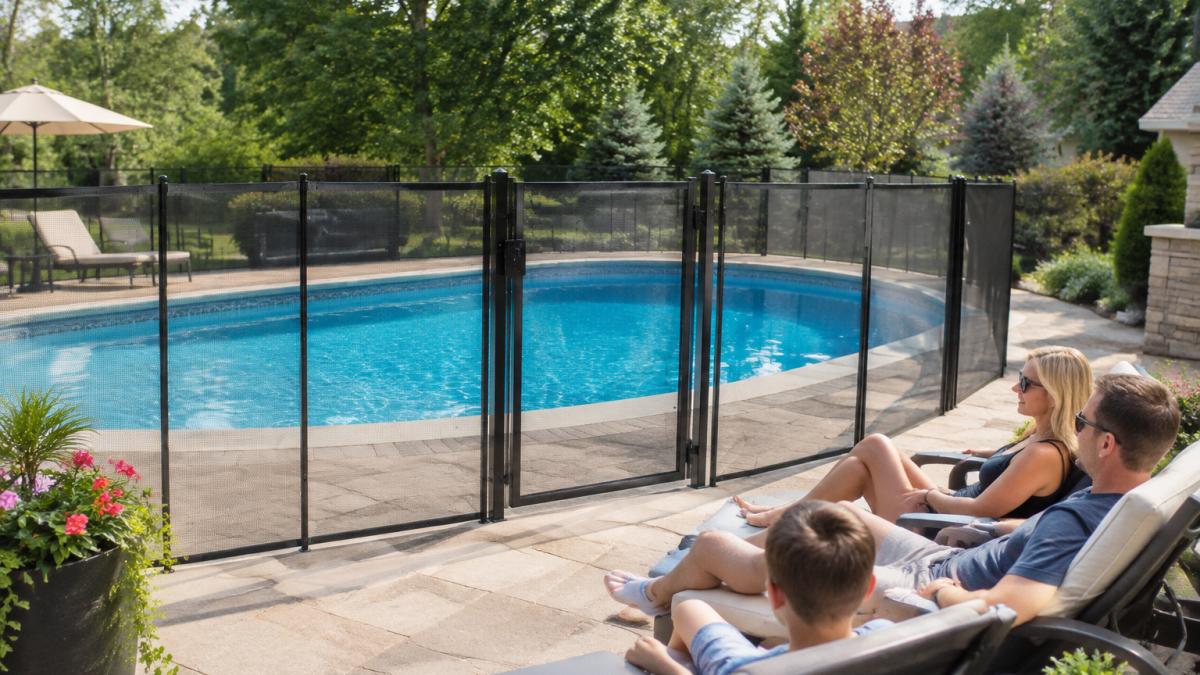
The core safety measures insurers and codes tend to expect:
- A safety fence separating the pool from the house and yard
- A self-closing, self-latching gate
- A locking gate or lockable cover
Local building codes set the enforceable minimums. Your insurer may ask for more. Our guide on whether pool companies handle building permits explains who manages that paperwork.
Fence Height, Self-Closing Gates, and Latching Hardware
Fence height rules differ by jurisdiction, so check your local code. What matters for insurance is function: the barrier must actually keep children out.
- Gates must close and latch on their own
- Latches should sit high enough that small children cannot reach them
- Fence gaps and climbable rails undermine the barrier
Diving Boards, Slides, and Higher-Risk Features
Diving boards and slides increase risk exposure, and some insurers treat them as a reason to raise premiums or decline coverage. If you want either feature, ask your insurer before you build. It is far easier to adjust a plan than to discover a coverage problem after installation.
Coverage Gaps to Watch: Construction, Renovation, and Claims
A pool under construction is a different risk from a finished pool, and the coverage transition is where homeowners get surprised. Responsibility for insuring the work shifts between you, your builder, and your policy at points that are easy to miss.
Who Insures What During Construction
Three parties can carry risk during a pool build, and the contract should say which one does:
- Your homeowners policy. Many policies extend some coverage to materials and structures on the premises during construction, but the scope varies. Some exclude or limit coverage for structures being built, and some require notification before work begins. Read the policy language or ask your agent directly.
- The builder's general liability policy. This covers the builder's liability for injuries to workers and third parties and for damage the builder causes to your property. Ask for a certificate of insurance before work starts and confirm the limits.
- Builder's risk coverage. This is property coverage on the work itself, materials, equipment, and the partially built structure, against fire, theft, vandalism, and weather. On larger projects the builder may carry it; on smaller residential jobs it is often absent. If no one carries it, you are self-insuring the work in progress.
Homeowners should not assume the builder's insurance covers everything, and should confirm coverage responsibilities in the contract. The contract should close that gap in writing.
Excavation, Underground Damage, and Utility Strikes
Excavation is the highest-risk phase. Striking a utility line, damaging a neighbor's irrigation or drainage, or causing settlement to an adjacent structure can produce claims that fall outside a standard pool coverage discussion. Before digging:
- Confirm the builder calls for utility locates and follows the resulting markings
- Ask who is responsible if a utility is struck despite locates
- Confirm the builder's liability coverage responds to damage to third-party property
Watch out: earth movement and settling exclusions are common, and a claim for cracking caused by excavation or soil movement may be denied even when the pool itself is covered.
Renovation and Major Repair: When to Notify the Insurer
A resurfacing job is not the same risk as a full renovation, but both can change your coverage position. Notify your insurer before major work when the project involves:
- Removing or replacing the pool shell or liner
- Adding a slide, diving board, or other feature that affects liability
- Changing the deck, enclosure, or barrier configuration
During the work, the barrier may be down, the pool may be empty, and the site may be unattended. Those conditions raise both liability and property risk, and some policies require disclosure.
Claims Scenarios: How Coverage Decisions Actually Get Made
Claims turn on three questions: was the damage a covered peril, was maintenance neglected, and did the safety features meet requirements.
- Windstorm tears a screen enclosure. Covered peril, no maintenance issue, barrier intact. Likely covered under other structures coverage, subject to deductible and the coverage basis.
- Liner fails from age. Gradual deterioration, not a covered peril. Likely denied as wear and tear, the most common pool property claim disappointment.
- Pump fails after years of skipped service. Neglect exclusion likely applies. Denied.
A Practical Pre-Work Checklist
Before construction or major renovation begins:
- Read your policy's construction and vacancy provisions, or ask your agent to summarize them
- Get the builder's certificate of insurance and confirm general liability limits
- Confirm in the contract who carries builder's risk on the work in progress
Insurance Information Institute guidance on homeowners coverage is a useful starting point for understanding how policies treat structures and liability. Planning the budget side matters too, and our guide on avoiding budget overruns on pool projects covers how to build contingency into the plan.
Your Pre-Installation Insurance Review Checklist
Run this checklist before signing a pool contract. It takes one call to your agent and saves surprises later.
- Confirm whether the pool falls under dwelling or other structures coverage
- Ask whether replacement cost or actual cash value applies
- Review your personal liability limit and raise it if needed
Vetting the builder is part of this review. Our pool builder checklist covers licenses, contracts, and timelines that affect your liability.
Planning a Pool Project? Start With a Consultation
The insurance side is manageable once you know what to ask. The bigger decision is who builds the pool.
Howland Pools designs and builds custom inground pools, spas, patios, enclosures, and outdoor kitchens, all with one team from start to finish. A free consultation is available to talk through your project.
Ready to plan? Request a quote for custom pool installation and see what your project looks like on paper before you commit. You can also learn more about Howland Pools and how we handle a project end to end.
Frequently Asked Questions
Does homeowners insurance cover an inground pool?
Yes, in most cases. A standard homeowners policy typically covers the pool structure under other structures coverage and the pump, filter, and heater under personal property coverage. Liability coverage extends to pool-related injuries on your property. However, damage from wear and tear, freezing, or poor maintenance is usually excluded, so review your policy wording and confirm the pool is listed before you rely on it.
How much does pool insurance cost per month?
There is no single rate. Your swimming pool insurance cost depends on your home's value, the pool's replacement cost, your liability limits, your deductible, and the safety features you have in place. Higher liability limits generally raise the premium, so review the right level with your agent. Ask your agent for a quote that lists the pool specifically so you can see the added cost.
Do I need a fence around my pool for homeowners insurance?
Most insurers expect a barrier, and many require one before they will insure an inground pool. Pool fence insurance requirements vary by carrier, but fence requirements typically include a self-closing, self-latching gate. Local building codes set the enforceable rules, so check both your policy and your municipality's requirements.
Should I tell my insurance company before installing an inground pool?
Yes. Call your insurer before construction begins. An inground pool raises your risk exposure, and an unreported pool can lead to a claim denial or a policy cancellation. Your agent can confirm whether your current policy covers the pool during construction, adjust your liability limits, and tell you which safety features earn a discount. Do this before you sign a contract with any installer.
A pool is a big investment, and the insurance details should not be an afterthought. Work with a builder who plans the whole project with you, from permits to the finished patio. Get started with Howland Pools and build a backyard you can enjoy with confidence.