What to Look for in Pool Builders: 2026 Checklist
Table of Contents
- Why Vetting Pool Builders Matters Before You Sign
- How to Evaluate a Pool Builder's Experience and Track Record
- Questions to Ask a Pool Builder Before Hiring
- Your Pool Builder Checklist: Licenses, Insurance, and Credentials
- Design Expertise, 3D Renderings, and Custom Design Plans
- Pool Construction Contract Checklist: Scope, Payments, and Safeguards
- Pool Construction Timeline, Permits, and Project Management
- Aftercare, Maintenance, and Lifetime Operating Costs
- Frequently Asked Questions
Last Updated: October 19, 2026
Why Vetting Pool Builders Matters Before You Sign
A swimming pool is one of the largest investments a homeowner will ever make, and the company you hire matters as much as the design.
The difference between a pool you enjoy for decades and one that drains your savings usually comes down to vetting, not luck.
Many homeowners focus on the design rendering and the bottom line, then treat credentials as an afterthought. That is backwards.
How to Evaluate a Pool Builder's Experience and Track Record
Start with proof, not promises. A qualified pool builder should demonstrate years of completed inground pool and spa projects, a portfolio you can review, and local references who will speak candidly.
Ask how long the company has operated under its current name and ownership. Longevity signals stability, but look for consistent workmanship across many projects, not a single showpiece.
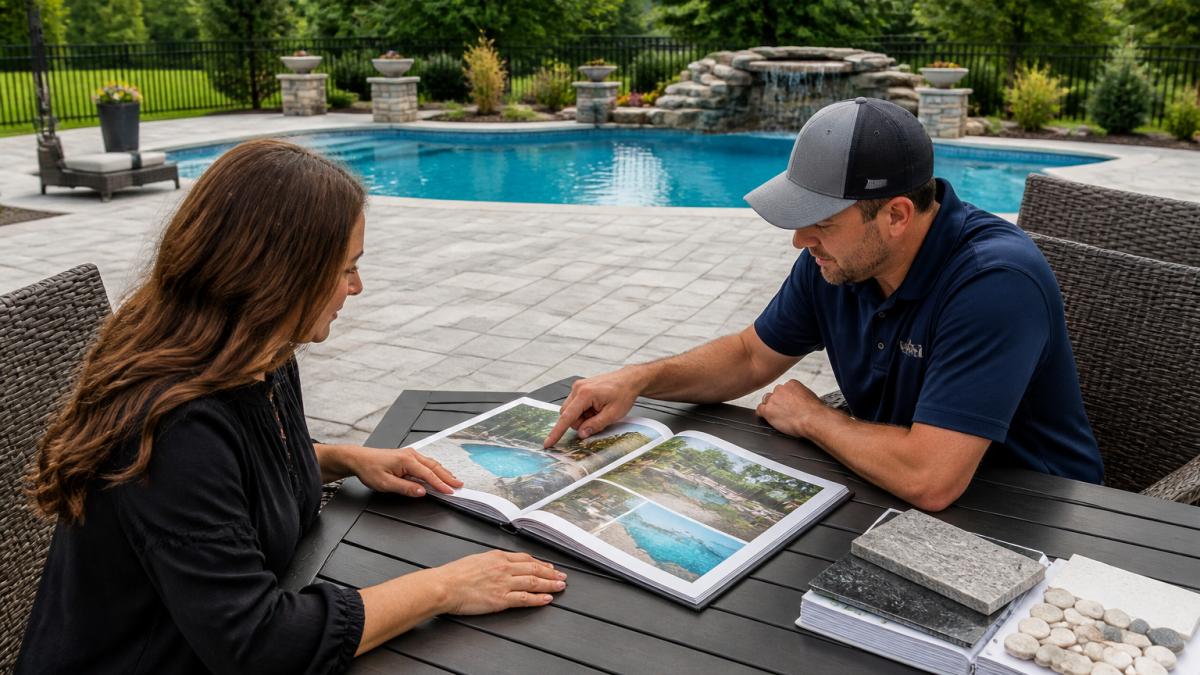
Portfolios, Completed Projects, and Local References
A portfolio should show finished pools, not just 3D concepts. Ask to see projects similar to yours in size, shape, and site conditions, including small-lot builds if your yard is tight. Local references matter because soil, climate, and code requirements vary by region.
Questions to Ask a Pool Builder Before Hiring
The best pool builder checklist starts with direct questions. Ask each contractor the same set so you can compare responses side by side.
- How many pools have you built in the last three years, and can I see examples?
- Who pulls the permits, and are you handling inspections?
- Who will be my main point of contact during construction?
- What is your process if we disagree about workmanship?
- Do you subcontract excavation, plumbing, or electrical work?
- What does your written estimate include, and what is excluded?
- How do you handle change orders and their cost?
- What does your warranty cover, and for how long?
A builder who hesitates on permit handling or warranty terms is telling you something: responsiveness during sales usually predicts responsiveness during construction.
Your Pool Builder Checklist: Licenses, Insurance, and Credentials
Verify credentials in writing before signing anything. Ask for the contractor's license number, certificate of insurance, and bonding information, then confirm them independently with the issuing body or local licensing authority.
A pool contractor should carry general liability insurance, which protects your property if something is damaged, and workers' compensation, which protects you if a crew member is injured on your property.
Many states and municipalities require specific licensing for pool construction, and requirements vary widely. The U.S. Small Business Administration's guidance on hiring contractors offers a useful overview of the documents to request.
| What to Verify | Why It Matters | How to Confirm |
|---|---|---|
| Contractor license | Legal authority to build | State licensing board lookup |
| General liability insurance | Covers property damage | Current certificate from insurer |
| Workers' compensation | Covers crew injuries | Certificate and insurer call |
| Bonding | Protects against non-completion | Bond number and issuer |
| Business registration | Confirms legitimate entity | State business registry |
Design Expertise, 3D Renderings, and Custom Design Plans
Good design is more than a pretty picture. A skilled builder translates your ideas into a buildable plan that accounts for your yard's grade, drainage, sun exposure, and how your family will use the space.
Ask whether 3D renderings are included and whether they reflect the final materials and dimensions. A rendering should show the pool in the context of your home, patio, and landscaping.
Custom design should also address how the pool connects to patios, enclosures, and outdoor kitchens. At Howland Pools, we design pools, patios, enclosures, and outdoor kitchens as one cohesive backyard living space, so the finished retreat matches the vision you approved on paper.
Pool Construction Contract Checklist: Scope, Payments, and Safeguards
The contract is where good intentions become enforceable promises, and where most pool disputes are won or lost. A solid pool construction contract checklist covers scope of work, payment schedule, change orders, warranty terms, lien protection, and dispute resolution. Treat it as a comparison tool: the same clauses should appear in every bid.
Compare Bids on Scope, Not Just the Bottom Line
A written estimate should specify dimensions, depth profile, shell construction method, finish material, coping, decking square footage, equipment brands and model numbers, electrical and plumbing scope, and exclusions. The lowest bid is frequently the one with the most exclusions, an omitted deck, a missing heater, or a pump listed only as "standard." Mark every bid against the same line-item grid; if one is thousands lower, find the missing line.
Structure Payments Around Milestones, Not Calendar Dates
A reasonable payment schedule ties each draw to a completed, inspectable milestone: a deposit at signing, draws at excavation, shell completion, and equipment installation, and a final payment after the final inspection and walkthrough. Be cautious of large upfront deposits or any schedule that asks for most of the money before most of the work is done. Hold back a meaningful final payment until punch-list items are resolved, and get each draw trigger in writing.
Change Orders: Get the Math in Writing
Change orders are normal on pool projects, soil conditions, grade surprises, and design tweaks happen. What matters is the procedure: the contract should require written approval before any change work begins, with added cost and schedule impact stated on the change order. Ask how the builder prices changes, hourly plus materials, fixed markup, or flat fee. Without a written procedure, a verbal "we'll take care of it" can become a disputed invoice.
Lien Waivers and Payment Protection
Subcontractors and material suppliers can file a mechanics lien against your property if they are not paid, even if you paid the general contractor in full. Ask for conditional lien waivers from the builder and major subcontractors at each draw, and a final unconditional waiver at closeout. A builder resistant to providing them is a serious red flag.
Warranty, Cancellation, and Dispute Terms
Get the warranty in writing and read what it covers: shell/structure, finish surface, plumbing, equipment (often covered by the manufacturer), and labor. Note each duration and whether it transfers if you sell. The contract should also state a cancellation and refund policy, a completion date (or estimate with a weather-delay process), and a dispute-resolution path, mediation before litigation is common.
| Contract Element | What to Look For | Red Flag |
|---|---|---|
| Scope of work | Itemized materials, dimensions, equipment model numbers, exclusions listed | Vague "standard" language, no exclusions section |
| Payment schedule | Draws tied to completed milestones, meaningful final holdback | Large upfront deposit, payments tied to dates |
| Change orders | Written approval required before work, cost and schedule impact stated | Verbal approvals, open-ended hourly billing |
| Lien protection | Conditional waivers at each draw, final unconditional waiver at closeout | Builder unfamiliar with or resistant to waivers |
| Warranty | Written, itemized by component, duration stated, transferability noted | Verbal promises only |
| Dispute resolution | Mediation-first path, cancellation and refund terms | No process defined |
Pool Construction Timeline, Permits, and Project Management
Most inground pool projects run from several weeks to a few months depending on size, site conditions, weather, and permitting, but "a few months" is not a schedule. Ask for a phase-by-phase timeline in writing, with the inspections that hold each phase and the dependencies that can move the completion date.
A Realistic Phase-by-Phase Timeline
A typical inground project moves through recognizable phases. Exact durations vary by region, pool type, and site, but the sequence is consistent:
- Design, engineering, and permitting, plan finalization, structural engineering where required, and permit application and approval. This is often the longest single phase and is largely outside the builder's control once submitted.
- Site prep and excavation, layout, access, digging, and spoil removal. Soil conditions and yard access drive the pace here.
- Shell construction, steel/rebar, plumbing rough-in, electrical rough-in, and shell placement (gunite/shotcrete, panel, or fiberglass depending on the build).
- Inspections, rough plumbing and electrical inspections typically must pass before the shell is finished or decking begins. A failed inspection stops the job until corrected and re-inspected.
- Finishes and decking, interior finish, coping, tile, and deck pour or install. Cure times matter and cannot be compressed.
- Equipment and startup, pump, filter, heater, sanitation, and automation installation, then fill, startup chemistry, and owner walkthrough.
Ask the builder to attach approximate durations to each phase and to identify which are weather-sensitive. Excavation, shell placement, and decking are most exposed to rain, freeze, and heat.
Permits, Zoning, and Site Feasibility
Permits are a frequent source of delay. Before construction, the builder should confirm zoning and setback requirements, easements, utility locations, drainage and grading, and safety-barrier requirements. Ask directly whether the builder handles permit applications, inspections, and code compliance, or whether that falls on you, a professional pool contractor typically manages the paperwork. Confirm who pays permit fees and who is responsible if a plan revision is required.
Project Management: Who Owns the Schedule
Project management matters as much as the plan. Know who your single point of contact is, how often you will get updates (weekly is reasonable), and what happens if weather or inspections push the schedule. Ask how the builder sequences subcontractors, excavation, plumbing, electrical, decking, and finish crews are often separate trades, and gaps between them are where schedules slip.
When the Schedule Slips
The contract should define what counts as a delay and how it is handled. Ask for a written process for schedule changes and a defined completion date or reasonable estimate. The U.S. Environmental Protection Agency's guidance on pool and spa safety is worth reviewing so you understand compliance expectations before construction begins, and your local building department can confirm which inspections apply to your project.
Aftercare, Maintenance, and Lifetime Operating Costs
The cheapest pool to build is not always the cheapest to own.
Pumps, heaters, and lighting account for most of a pool's ongoing energy use, and efficient equipment can reduce monthly costs over the life of the pool.
Also clarify what happens after the final walkthrough. Does the builder provide start-up service, water chemistry guidance, and a maintenance schedule?
The U.S. Department of Energy's guidance on pool and spa heating explains how equipment choices affect operating costs, which is useful context when comparing bids.
Choosing a pool builder is a decision about trust, and trust is built on verified credentials, transparent contracts, and clear communication. If you are planning a custom inground pool or a full backyard renovation in Northeast Ohio, Howland Pools designs and builds pools, patios, enclosures, and outdoor kitchens as one cohesive project, managed start to finish by a single team.
Frequently Asked Questions
How do I choose a reputable pool builder?
Start by verifying the contractor's license, bonding, and insurance, then ask for a portfolio of completed projects and a list of local references you can call. Read customer reviews and look for consistent feedback on communication and workmanship. Request a written estimate and a detailed contract before paying any deposit. A reputable pool contractor will welcome these questions and provide documentation without hesitation.
What credentials should a pool builder have?
At minimum, a pool builder should hold the state and local licenses required for pool construction in your area, carry general liability insurance, and be bonded. Ask for proof of workers' compensation coverage as well. Certifications from industry associations add credibility, but licensing and insurance are the non-negotiable basics. Verify each document directly rather than accepting verbal assurances, and confirm the license is active and in the company's legal name.
What are red flags when hiring a pool builder?
Watch for large upfront deposit demands, no written contract, pressure to sign quickly, vague timelines, and reluctance to provide references or proof of insurance. A builder who cannot show completed projects in your area or who avoids putting scope and payment terms in writing is a risk. Also be wary of quotes far below competitors; unusually low bids often lead to change orders or cut corners later.
What should be included in a pool construction contract?
A solid contract names the exact scope of work, materials and equipment with model numbers, a payment schedule tied to milestones, a start and completion date, permit responsibilities, warranty terms, and a change-order process. It should also address site cleanup, dispute resolution, and what happens if the schedule slips. Read every line before signing, and ask for clarification on anything vague.
How long does it take to build an inground pool?
Most inground pool projects take several weeks to a few months from excavation to completion, depending on design complexity, site conditions, weather, and permit timelines. Ask your pool builder for a written schedule with milestones so you can track progress. Factor in that permit approval and material lead times can add weeks before digging even begins.
What should I expect during pool construction?
Expect excavation, plumbing and electrical rough-in, shell construction, decking, and equipment installation in sequence, with inspections at key stages. Your yard will be an active work site, so plan for limited access and some noise. A good pool contractor communicates the schedule, keeps the site organized, and tells you in advance when decisions or payments are due.